
Where to Buy the Best Spotlight LED Lights in China?

Choosing the best Spotlight Led Lights in China requires more than comparing prices or counting product images. Buyers must examine optical performance, heat management, driver quality, certifications, and supplier reliability. A bright sample can still create glare, flicker, or uneven illumination after installation.

The International Energy Agency reports that lighting represents approximately 15% of global electricity consumption. This figure explains why efficient LED selection matters in retail stores, hotels, galleries, and residential projects. The U.S. Department of Energy also identifies LED products as highly efficient and long-lasting, although real performance depends on thermal design and operating conditions. Specifications matter.

China remains a major lighting manufacturing center, supported by extensive component, testing, and export networks. However, factory scale alone does not prove product quality. Professional buyers should request LM-79 photometric reports, LM-80 data for LED packages, flicker measurements, power-factor results, and clear warranty terms. Products entering different markets may also require CE, RoHS, UKCA, or other applicable compliance documentation. China’s GB standards should be checked when products are intended for domestic installations.

A useful supplier comparison should include beam angle, color rendering index, color temperature, lumen output, housing material, IP rating, dimming compatibility, and replacement support. Ask for a working sample. Inspect it after several hours of operation.

Small details reveal weaknesses.

This guide evaluates where to buy dependable Spotlight Led Lights in China, including manufacturer-direct factories, specialized lighting distributors, and sourcing platforms. Some conclusions may remain imperfect because supplier capabilities change quickly. Independent testing is still essential before placing a large order.
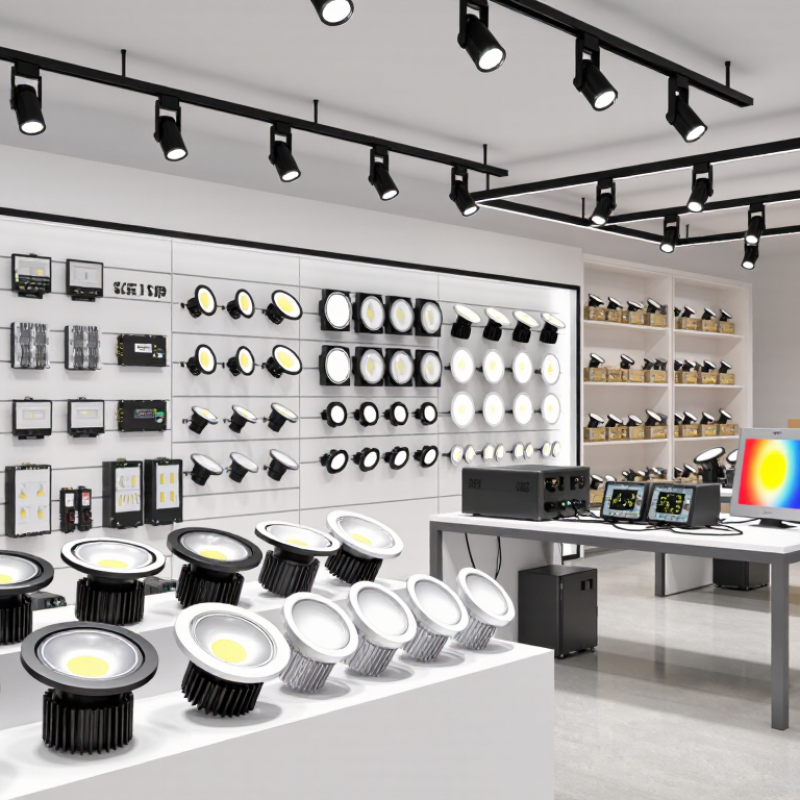
Where to Buy the Best Spotlight LED Lights in China?

What Defines a High-Quality Spotlight LED Light?

A high-quality spotlight LED should make the target clear without turning nearby surfaces harsh or washed out. Check beam angle, measured in degrees, and compare it with the room’s ceiling height and the object’s size. A narrow beam suits a small display; a wider beam can soften shadows across a counter. Color quality matters, too. Look for a stated color rendering index, or CRI, of 90 or higher when accurate colors matter. Ask for an LM-79 test report, which records photometric and electrical performance under controlled conditions. Numbers beat attractive packaging.

Efficiency and heat control deserve equal attention. The U.S. Department of Energy’s Energy Saver guidance says LEDs use at least 75% less energy and last up to 25 times longer than incandescent lighting. Those figures describe LEDs broadly, not every spotlight, so check the product’s tested wattage, lumen output, and rated life. Inspect the housing and heat sink; a compact lamp that runs hot may age poorly. Ask suppliers in China for flicker data, dimmer compatibility, warranty terms, and reports from an independent laboratory. A sample tells you more than a catalog photo. I would test one in the actual fixture before ordering a batch. It is a small extra step, and sometimes an inconvenient one.

Which Regions in China Produce Spotlight LED Lights?

China’s spotlight LED production is concentrated in Guangdong, where lighting factories, component suppliers, and export services operate close together. Zhongshan, especially the Guzhen area, is known for its dense lighting industry. Buyers can find factories producing recessed downlights, track spotlights, and adjustable fixtures. Shenzhen and Dongguan add strengths in electronics, drivers, and precision assembly. A short drive can reveal a very different supplier base. That matters.

Other useful clusters include Zhejiang and Jiangsu, where manufacturers make lighting products and related electrical components. However, a supplier’s registered address may be an office rather than its production site. Ask for the factory location, a recent production video, and details about testing equipment. For spotlights, check beam angle, color consistency, heat management, and driver compatibility. Request a sample before discussing large orders. Small details count. A sample that looks bright in a showroom may show uneven color on a real ceiling. Regional reputation helps narrow a search, but it does not prove quality. Factory visits or independent inspections can confirm whether the workshop, staff, and production process match the supplier’s claims.

Where to Buy Spotlight LED Lights in China? Guangdong is a key place to start, particularly Zhongshan, home to the Guzhen lighting hub, and Shenzhen. Ningbo in Zhejiang is another established lighting-manufacturing location. The chart counts the named locations shown; it does not represent production volume or market share.

Where Can Buyers Find Spotlight LED Suppliers in China?

Where Can Buyers Find Spotlight LED Suppliers in China?

Buyers can find spotlight LED suppliers through established lighting districts, trade fairs, and verified business-to-business directories. In person, visit showrooms and factories when possible. A showroom helps you compare beam angles, housing finishes, and color temperatures under the same conditions. Ask whether samples come from regular production, not a specially prepared batch.

Online research can narrow the field, but a polished listing is not proof of manufacturing capability. Request product specifications, recent test reports, and clear photos of the production line. Check details such as wattage, lumen output, color rendering, dimming compatibility, and heat dissipation. Ask how the supplier handles failed samples and production changes. Details matter.

Before placing a large order, test samples in the actual ceiling or display area. A narrow beam may create harsh circles on a textured wall, even when the catalog looks convincing. Compare packaging, labels, and batch consistency, too. Some suppliers answer quickly but provide vague technical information; that is worth noticing. Ask for written answers and confirm lead times, minimum order quantities, and inspection arrangements. Then compare the full offer, not just the unit price.

How to Evaluate Manufacturers and Product Quality

When sourcing spotlight LED lights in China, judge the manufacturer, not just the product photos. Ask for the factory’s address, production scope, and recent inspection records. A trading company may still be useful, but clarify who controls design changes and quality checks. Request a sample from the same production line used for bulk orders.

Check the photometric report for beam angle, lumen output, and color consistency. Compare its measurements with a simple test in a dark room; a narrow beam should form a clear pool without obvious rings. Ask for the LED’s color rendering and color temperature data, plus driver specifications and thermal test results. Ask for raw files. Confirm that test reports match the exact model, not a similar fixture. Inspect the housing, wiring, and lens for rough edges, loose parts, or uneven finish. These details can expose rushed assembly.

Discuss warranty terms, replacement parts, packaging, and lead times in writing. Request a small pilot order and inspect several units, since one good sample proves little. A factory visit or live production video can help, but neither replaces independent testing. Some checks take time, and I would not treat a tidy showroom as proof of consistent quality.

Where to Buy the Best Spotlight LED Lights in China? — How to Evaluate Manufacturers and Product Quality

Use this checklist to compare suppliers and sample products. The figures below are practical screening benchmarks, not universal requirements; confirm that each specification suits the installation, market, and applicable regulations.

Evaluation Area What to Check Useful Evidence or Screening Benchmark Warning Signs
Supplier capability Confirm whether the supplier designs and manufactures the spotlight, outsources production, or acts as a trading intermediary. Review production controls, incoming inspection, assembly, and final testing. Request a factory audit or live production walkthrough, process-control records, and a written explanation of which components and processes are made in-house. Unclear production location, inconsistent answers about manufacturing, or refusal to explain quality-control procedures.
Photometric performance Compare delivered lumens, beam angle, center-beam intensity, and light distribution for the exact model and configuration. Ask for a photometric test report and IES or LDT file. For many general-purpose applications, a beam angle around 15°–60° may be considered, but the correct choice depends on mounting height and target area. Only chip-level lumen figures are provided, or the beam angle and output differ between the quotation, sample, and test report.
Energy performance Check input power and luminaire efficacy, including the effect of the driver, optics, and thermal design. Compare measured luminaire lumens per watt rather than LED-chip claims alone. A value around 80–120 lm/W can be a useful initial screening range for many commercial spotlights; application and design affect results. Efficiency claims lack a test basis, or the stated wattage and measured power do not match the product specification.
Color quality Review correlated color temperature (CCT), color rendering, and consistency between units or batches. Common CCT options include 2700 K, 3000 K, 4000 K, and 5000 K. CRI (Ra) of 80 or higher is a common baseline; 90 or higher may be preferred where color appearance matters. Request measured data for the selected model. Only a generic “high CRI” claim is supplied, or color varies noticeably between samples with the same specification.
Flicker and dimming Test the spotlight with the intended control system at full and reduced output. Check for visible flicker, unstable dimming, noise, and compatibility issues. Request driver and dimmer compatibility information, plus flicker measurement data when the installation is sensitive to flicker, such as video or task lighting. Dimming performance is promised without naming compatible control types, or the light flashes, drops out, or buzzes during testing.
Thermal design and lifetime Inspect heat-sink construction and ask how operating temperature and LED maintenance claims were established. Request LM-80 data for the LED source and the applicable TM-21 projection where relevant. Treat projected LED-source maintenance as distinct from the lifetime of the complete luminaire; review warranty terms separately. A long lifetime claim is presented without supporting data, operating conditions, or a clear warranty definition.
Electrical and product safety Check rated voltage, frequency, insulation, grounding or Class II construction, and protection against electric shock for the intended installation. Ask for safety test documentation applicable to the destination market and product type. IEC 60598-1 is a general luminaire safety standard; recessed luminaires may also require consideration of IEC 60598-2-2. Certificates or reports do not identify the exact model, contain inconsistent ratings, or come from an unverifiable source.
Ingress protection and construction Match the IP rating to the actual exposure, and inspect the lens, housing, joints, connectors, and any sealing features. IP codes are classified under IEC 60529. Request evidence for the claimed rating and verify that the tested construction matches the supplied product. An IP rating is advertised without supporting test evidence, or a sample’s seals and housing differ from the documented design.
Component traceability Identify the LED source, driver, optics, and other critical components, and confirm how substitutions are controlled. Request a bill of materials or approved-component list and a written change-notification process. Confirm that sample and production units use the agreed components. Critical components are described only in vague terms, or substitutions can be made without notice or approval.
Testing and documentation Check that test reports cover the exact model, wattage, CCT, driver, and configuration being purchased. Where appropriate, seek photometric reports based on recognized methods such as ANSI/IES LM-79, and verify laboratory accreditation and report details with the issuing laboratory. Reports cover a different product, omit key configuration details, or cannot be independently verified.
Sample and production consistency Evaluate a pre-production sample, then compare it with goods from a pilot or production batch. Record the agreed specifications and acceptance criteria for output, color, dimensions, appearance, and function. Use an agreed inspection plan before shipment. The approved sample is not retained as a reference, or production results are accepted without documented inspection.
Commercial terms and after-sales support Clarify minimum order quantity, lead time, packaging, spare parts, warranty coverage, and responsibility for defects or replacements. Put specifications, approved samples, inspection requirements, delivery terms, and warranty conditions in writing before placing an order. Important terms are only verbal, warranty exclusions are unclear, or the supplier cannot provide a defined process for handling quality claims.

What to Check Before Ordering and Shipping Spotlight LEDs

Before ordering spotlight LED lights from China, define the job they must do. Check the beam angle, lumen output, color temperature, and color rendering index on the product datasheet. A narrow beam can highlight a display, while a wider one may suit a work area. Confirm the input voltage and dimming method match your installation. Small details matter. Ask for written confirmation, not just a sales chat.

Review the supplier’s technical documents and request a sample when the order is significant. Test it in the actual fitting if possible. Look for flicker, uneven light, excess heat, and a secure connection after the lamp has run for a while. Check whether stated performance figures apply to the complete lamp or only the LED chip. That distinction is easy to miss. I would not judge consistency from one sample alone; batch variation is worth discussing before payment.

Before shipment, agree on quantity, packaging, lead time, and who handles each transport cost. Ask how the lamps will be protected from impact and moisture, and request carton dimensions and gross weight for freight planning. Confirm that the invoice, packing list, and any requested test reports match the order. Keep a record of approved specifications and sample photos. Shipping estimates can shift, so leave room in your schedule.

x